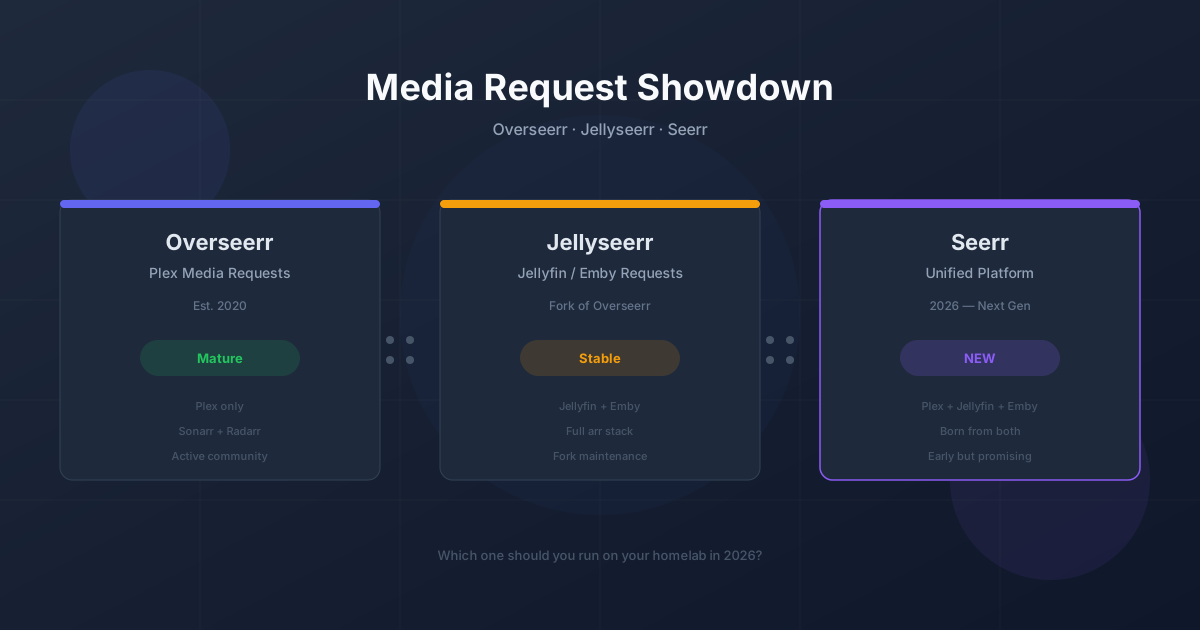
Overseerr vs Jellyseerr vs Seerr: Best Media Request Manager for Your Homelab in 2026
Stop letting friends text you what movie they want to watch. Three self-hosted request managers — overseerr, jellyseerr, and the new seerr — compared for Plex, Jellyfin, and Emby users.
You know the feeling. Someone asks to watch a movie, you SSH into your server, open Sonarr, search, add, and wait for the download. Then you text back “it’s up” — assuming you remembered.
I ran my Plex server for two years before I discovered that this entire workflow could be automated. Turns out, there’s a whole category of tools that let your users request content themselves — no terminal access required.
Three tools dominate today: Overseerr (the original), Jellyseerr (the fork), and Seerr (the newcomer that merges both). Here’s what each does, who they’re for, and which one you should run.
What These Tools Actually Do
Before comparing, let’s be clear on the problem. You’ve got a media server (Plex, Jellyfin, or Emby) connected to automation tools (Sonarr for TV, Radarr for movies, maybe Bazarr for subtitles). Your friends or family can browse your library, but they can’t add anything.
Request managers bridge that gap:
- Users browse upcoming and popular content through a clean web UI
- They click “request” on something that’s not in your library
- The tool checks Sonarr/Radarr, adds the item, and notifies everyone when it’s available
- You sit back and stop being tech support
I’ve been running one of these for about two years, and it genuinely changed how my household uses the media server. My partner stopped asking me to add stuff — she just opens the page and clicks.
🚀NordVPN
Access your media server securely from anywhere with a reliable VPN.
Affiliate link — we may earn a commission at no extra cost to you.
Overseerr — The Original, Plex-Only Workhorse
Overseerr started it all. It’s been around since 2020, has a massive community, and remains the most polished option if you’re running Plex.
What I like:
- The UI is gorgeous. This isn’t “self-hosted jank” — it looks like a real app
- Discovery features are genuinely useful. Trending, popular, upcoming — it scrapes from multiple sources
- User management is solid. You can set per-user request limits per month
- Auto-request approval for trusted users, manual approval for guests
- Webhook notifications (Discord, Telegram, Pushover, etc.)
The catch: It only works with Plex. If you switched to Jellyfin (like I eventually did), you’re out of luck.
Deployment is dead simple:
docker run -d \
  --name overseerr \
  -p 5055:5055 \
  -v ./overseerr-config:/app/config \
  lscr.io/linuxserver/overseerr:latest
Overseerr connects to your Plex server for authentication and library scanning, then links to Sonarr and Radarr for the actual automation. That’s it — three integrations and you’re done.
Jellyseerr — The Fork That Kept Jellyfin Users Alive
When Jellyfin started gaining real traction, Overseerr had no plans to support it. So the community forked it. Jellyseerr is literally Overseerr with Jellyfin and Emby support patched in.
What works:
- Same UI, same features, same workflow
- Jellyfin + Emby authentication and library integration
- Full arr stack support (Sonarr, Radarr, and yes, Bazarr too)
- Active development — it’s not abandoned
What doesn’t:
- You’re running a fork of a fork. Updates are manual when Overseerr releases something new
- Some edge cases around Jellyfin authentication (especially with hardware-accelerated login setups)
- The UI has minor rough edges that the Overseerr team would’ve smoothed out
I ran Jellyseerr for about a year after migrating from Plex to Jellyfin. It worked fine — never had a critical failure. But I always felt like I was running someone else’s project, not my own.
version: '3'
services:
  jellyseerr:
    image: fallenbagel/jellyseerr:latest
    container_name: jellyseerr
    ports:
      - "5055:5055"
    volumes:
      - ./jellyseerr-config:/app/config
    restart: unless-stopped
Seerr — The New Unified Player Entering the Ring
Here’s where it gets interesting. Seerr launched earlier this year as a rewrite — not a fork — that supports Plex, Jellyfin, and Emby natively.
Think of it as what Overseerr would be if it was rewritten today with all three ecosystems in mind from day one.
The good:
- Supports all three media servers out of the box — Plex, Jellyfin, Emby
- Built from scratch, no fork baggage or legacy quirks
- Modern tech stack (Node.js + React, well-architected)
- Active development with weekly releases — the team is clearly hungry
- Clean UI that feels fresher than Overseerr in some places
The caution:
- It’s new. The project is a few months old as of mid-2026
- Smaller community means fewer third-party integrations and guides
- Some features are still being built — user management is less granular than Overseerr
- You’ll encounter the occasional bug that the older projects have already fixed
I spun up Seerr on a test domain last month. The onboarding was smoother than both Overseerr and Jellyseerr — it detected my Jellyfin server automatically, found Sonarr and Radarr on the network, and was fully configured in under five minutes. That “it just works” feeling is rare in self-hosting, and Seerr nails it.
🚀NordVPN
Keep your media server access private and secure with NordVPN.
Affiliate link — we may earn a commission at no extra cost to you.
Head-to-Head Comparison
| Feature | Overseerr | Jellyseerr | Seerr |
|---|---|---|---|
| Plex support | ✅ Native | ❌ | ✅ Native |
| Jellyfin support | ❌ | ✅ Native | ✅ Native |
| Emby support | ❌ | ✅ Native | ✅ Native |
| Sonarr + Radarr | ✅ | ✅ | ✅ |
| Bazarr (subtitles) | ❌ (manual) | ✅ | ✅ |
| User management | ✅ Granular | ✅ Granular | ⚠️ Basic |
| Discovery features | ✅ Excellent | ✅ Excellent | ✅ Good |
| Notification channels | ✅ 8+ integrations | ✅ 8+ | ⚠️ Growing |
| UI polish | ⭐⭐⭐⭐⭐ | ⭐⭐⭐⭐ | ⭐⭐⭐⭐ |
| Project maturity | 6+ years | 3+ years | ~6 months |
| Deployment | Docker / bare | Docker / bare | Docker |
| Resource usage | ~200MB RAM | ~200MB RAM | ~300MB RAM |
Which One Should You Run?
The honest answer depends entirely on what media server you’ve got:
Stick with Overseerr if: You’re on Plex and you don’t plan to leave. It’s the most mature, most polished, and has the largest community. There’s zero reason to switch unless you hit its limitations.
Use Jellyseerr if: You’re on Jellyfin or Emby and need something that works today with zero surprises. It’s battle-tested, the community is active, and the “fork tax” is minimal for most users. If reliability is your priority, this is the safe bet.
Try Seerr if: You’re starting fresh, running a mixed household (Plex + Jellyfin users), or just want the newest unified platform. It’s not production-bulletproof yet, but it’s moving fast. I’d trust it on a secondary media server — not on my main production box just yet.
Personally? I’m watching Seerr closely. If its user management catches up to Overseerr’s in the next few months, I’ll migrate my whole setup. The unified approach is the right idea — we just need to give them time to bake.
Quick Deployment Guide
Whichever you pick, the setup is almost identical:
- Point the container at a port on your host (5055 is standard)
- Mount a config volume for persistence
- On first launch, connect to your media server
- Add Sonarr and Radarr API keys
- Set up users and notification webhooks
- Done — share the URL with your users
The whole process takes about 10 minutes. That’s ten minutes to stop being the family media concierge forever. Worth it.
Your Turn
Are you running Overseerr, Jellyseerr, or have you tried Seerr yet? I’m curious how the early adopters are finding it — drop me a line or leave a comment.
And if you’re still SSH’ing in manually to add movies for your family? Do yourself a favor and set one of these up this weekend. Your future self will thank you.
Stay in the loop 📬
Get self-hosting tutorials, tool reviews, and infrastructure tips delivered to your inbox. No spam, unsubscribe anytime.
Join 0 self-hosters. Free forever.