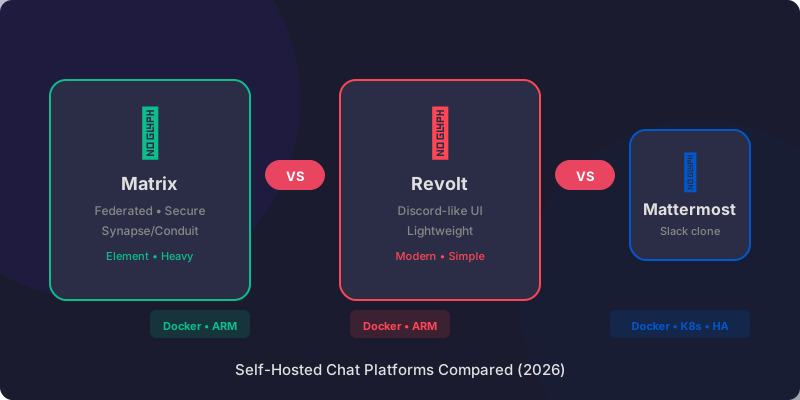
Self-Host Your Own Chat Server: Matrix vs Revolt vs Mattermost (2026)
I tested Synapse, Revolt, and Mattermost to replace Discord and Slack on my homelab. Here's what I learned about running your own chat infrastructure — and which one I actually use.
I love Discord. But I don’t love the idea of every DM, every file I upload, and every server I join living on someone else’s infrastructure. Same goes for Slack, Telegram, WhatsApp — they’re all someone else’s computer running someone else’s rules.
I’ve been on a mission to replace as much of this as possible with self-hosted alternatives. And honestly? Chat is the hardest thing to self-host well. Your friends won’t migrate, your communities are already somewhere else, and the setup can be a pain.
But for team communication, family groups, or just having a private space that’s yours? It’s worth it. Here’s what I found after running three different solutions.
The Contenders
Matrix (Synapse) — The big one. Decentralized protocol, end-to-end encryption, bridges to everything. Used by governments and enterprises. Also famously resource-hungry.
Revolt — The young challenger. Looks and feels almost exactly like Discord. Built with Rust and MongoDB. Much lighter than Matrix but way less mature.
Mattermost — The Slack replacement for teams. Threaded conversations, channels, integrations. Popular in FOSS circles. Feels like work (which may be what you want).
Let’s go through each one.
🧠 Matrix / Synapse — The Heavyweight
I started with Synapse. Everyone says “run Matrix” when you ask about self-hosted chat. It’s the O.G. open protocol, it’s what Element (the main client) runs on, and it’s probably the most feature-complete option out there.
The good: End-to-end encryption works. Bridges to Slack, Discord, Telegram, IRC, WhatsApp — you can centralize everything in one client. If you’ve got a family on WhatsApp and a team on Discord and you want to manage it all from one window, Matrix is the only option that does this properly.
The bad: It eats RAM like crazy. A single-user Synapse instance on a small VPS will happily chew through 1-2GB of RAM just sitting there. There’s been progress with Dendrite (the Go rewrite) but it’s not production-ready for most people yet. I tried running Synapse on a 2GB Hetzner box and it was constantly swapping.
Setup complexity: Medium-high. Docker makes it manageable, but you’re dealing with PostgreSQL, Redis, and Synapse itself. If anything breaks, debugging federation issues is not fun.
Who it’s for: People who need federation (talking to users on other Matrix servers), need bridges to other platforms, or need E2EE for compliance/security reasons.
🚀NordVPN
Running a federated chat server? Secure your infrastructure with a reliable VPN.
Affiliate link — we may earn a commission at no extra cost to you.
⚡ Revolt — The Discord Clone
Revolt caught my eye because it doesn’t try to be anything other than “Discord, but I own it.” The UI is almost a 1:1 match — channels, voice, roles, emojis, the whole thing.
The good: Lightweight compared to Matrix. Runs on MongoDB and a Rust backend. I had it up on a $6 VPS without any issues. The web client and desktop app are smooth. For a small group of friends who just want to chat without all the Matrix complexity, this is a solid pick.
The bad: No E2EE yet (it’s on the roadmap). No federation — it’s a single-server solution. The plugin ecosystem doesn’t exist the way Mattermost or Matrix have it. And the project is smaller, so if something breaks, you’re relying on a smaller community for help.
Setup complexity: Low. Docker Compose, set env vars, done. Took me about 20 minutes.
Who it’s for: Small teams or friend groups migrating from Discord. If you don’t need encryption or bridges to other platforms, and you want something familiar, Revolt is the easiest.
🏢 Mattermost — The Slack Replacement
Mattermost has been around forever. It’s what teams use when they want Slack without the Slack pricing.
The good: Rock solid. Threaded conversations, granular permissions, compliance exports, integrations with GitLab/GitHub/Jira. If you’re running a self-hosted stack for a small company or serious open-source project, this is the right tool. The mobile apps are actually good too.
The bad: It’s enterprise software. The UI shows it — it’s functional, not fun. Voice/video isn’t built-in the way Discord or Revolt handle it. And the truly good features (like advanced compliance) are locked behind the Enterprise license.
Setup complexity: Medium. Docker Compose with MySQL/PostgreSQL and a config file. Plenty of docs.
Who it’s for: Teams that need structured communication with audit trails. Developers who want deep integrations with their CI/CD pipeline.
📊 The Showdown
| Feature | Matrix/Synapse | Revolt | Mattermost |
|---|---|---|---|
| E2EE | ✅ Built-in | ❌ Planned | ✅ Available |
| Federation | ✅ (killer feature) | ❌ | ❌ |
| Discord-like UI | ❌ (Element is different) | ✅ (almost identical) | ❌ (Slack-like) |
| Resource usage | High (1-2GB RAM) | Low (~256MB) | Medium (~512MB) |
| Bridges | ✅ Tons | ❌ Few | ✅ Good (tool oriented) |
| Mobile apps | ✅ Element | ✅ Revolt | ✅ Mattermost |
| Voice/Video | ✅ Element Call | ✅ Built-in | ❌ (plugins only) |
| Setup time | 1-2 hours | 20 minutes | 45 minutes |
| Best for | Power users, federated chat | Friends replacing Discord | Teams replacing Slack |
Which One Should You Pick?
Here’s my honest take after running all three:
Choose Matrix/Synapse if: You want federation, you need to bridge multiple platforms, or E2EE is non-negotiable. Be prepared for the RAM cost or look into lighter homeservers like Conduit.
Choose Revolt if: You’re a small group looking to ditch Discord. It’s the easiest to set up and the most familiar to your friends who are used to the Discord UX. Just know you’re trading simplicity for features.
Choose Mattermost if: This is for work. Team communication, integrations with your dev tools, compliance logging — Mattermost does all of that properly.
For me personally? I run Revolt for my friend group (they’d never switch to Element) and Matrix/Synapse for private family communication where I actually want E2EE. Mattermost sits in my “when I have a team again” drawer.
What About Security?
Running any internet-facing chat server means you need to think about security. Synapse has had its share of CVEs over the years, and exposing any web service means you’re a target. A few things I’d recommend:
- Put it behind a reverse proxy — Traefik or Nginx Proxy Manager with automatic HTTPS
- Use a VPN for admin access — Don’t expose the admin panels to the open web
- Keep it updated — Chat software gets patched often. Watch the repos.
🚀NordVPN
Secure access to your self-hosted chat and admin panels from anywhere.
Affiliate link — we may earn a commission at no extra cost to you.
The Bottom Line
Self-hosting chat is more work than using Discord or Slack. That’s the truth. But once you’ve got your own server running, with your own data and your own rules, it’s hard to go back.
Start with the simplest option that covers your actual needs. For most people starting out, that’s Revolt. For power users with specific requirements, it’s Matrix. For teams, it’s Mattermost.
Pick one, get it running, and see how it feels. You can always migrate later — the whole point is owning your data, and that includes the freedom to switch whenever you want.
Stay in the loop 📬
Get self-hosting tutorials, tool reviews, and infrastructure tips delivered to your inbox. No spam, unsubscribe anytime.
Join 0 self-hosters. Free forever.